Workshop Philosophie der Mathematik/Philosophy of Mathematics
| Datum: | 29.05.2026, 11:00 - 13:00 Uhr |
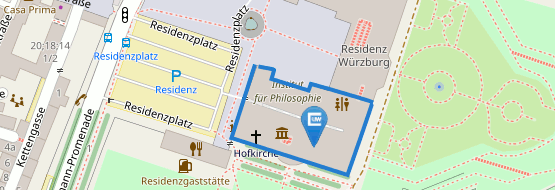
| Ort: | Neubaustraße 11, 280 |
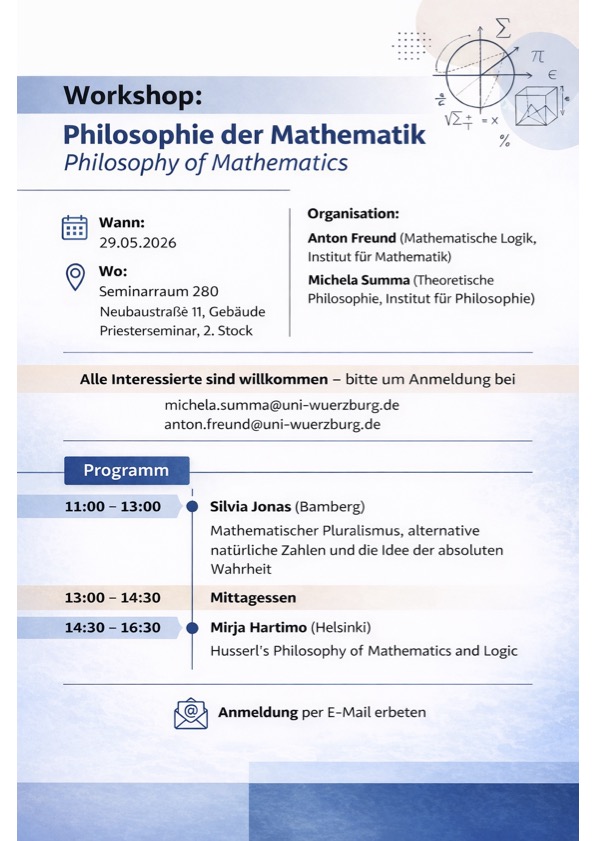
Workshop: Philosophie der Mathematik – Philosophy of Mathematics
Organisation:
Anton Freund, Mathematische Logik – Institut für Mathematik
Michela Summa, Theoretische Philosophie – Institut für Philosophie
Wann: 29.05.2026
Wo: Neubaustraße Raum 280
Alle Interessierte sind willkommen – bitte um Anmeldung bei michela.summa@uni-wuerzburg.de oder anton.freund@uni-wuerzburg.de
11:00-13:00 – Silvia Jonas, Bamberg
Mathematischer Pluralismus, alternative natürliche Zahlen und die Idee der absoluten Wahrheit
Abstract: Der mathematische Pluralismus geht davon aus, dass der mathematische Kosmos nicht nur eines, sondern viele, teilweise miteinander inkompatible Universen umfasst. Die Wahrheitswerte bestimmter mathematischer Aussagen, wie z.B. der Kontinuumshypothese, können folglich von Universum zu Universum variieren. Diese Vorstellung passt so gar nicht zur herkömmlichen Vorstellung von Mathematik als Reich absoluter, unverrückbarer Wahrheiten. In diesem Vortrag erläutere ich, weshalb die Annahme eines mathematischen “Multiversums” dennoch plausibel ist und betrachte dann die philosophischen Implikationen einer derzeit noch wenig beachtete Konsequenz dieser Position, nämlich die Existenz alternativer natürlicher Zahlen.
13:00-14:30 - Mittagessen
Der für den Nachmittag angekündigte Vortrag mit Mirja Hartimo entfällt leider, der Workshop endet gegen 13:00 Uhr.